When Bots Fail: Blending AI with the Human Touch
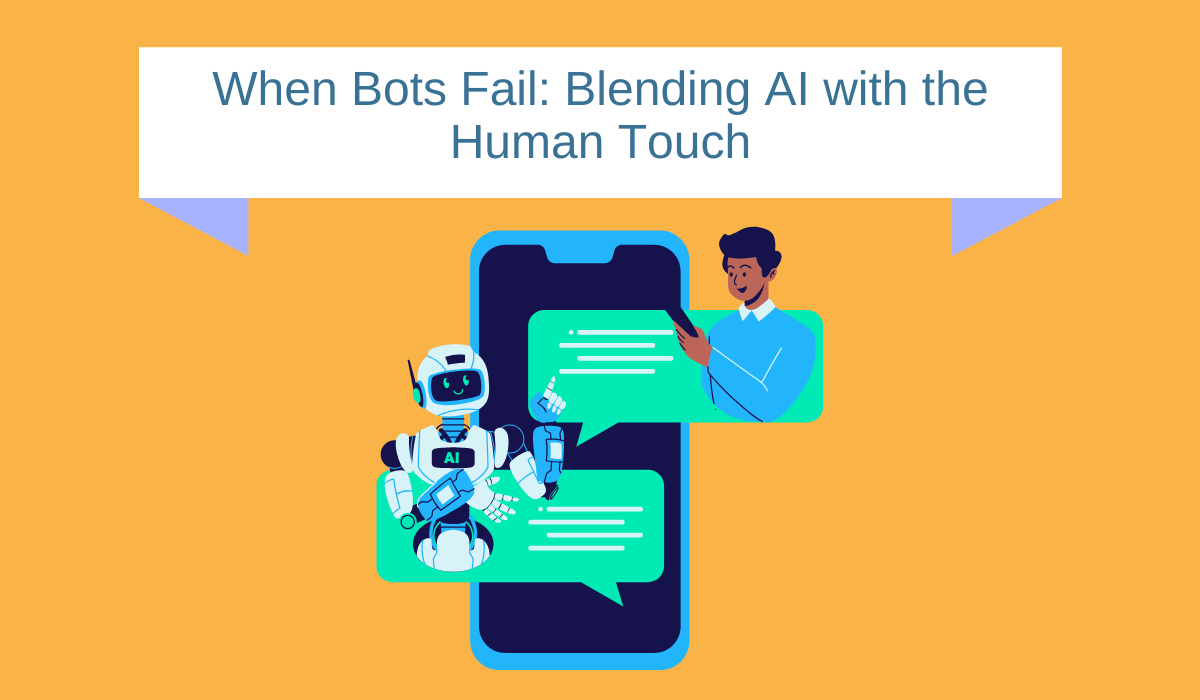
We’ve all been there as customers. You know that sinking feeling when you realize you’re about to fight with a chatbot for the next 20 minutes?
You need a quick answer about your bill, so you open the company’s chat. Twenty clicks later, you’re still stuck in an endless loop of ‘I didn’t understand that’ responses. When you finally type “SPEAK TO A HUMAN,” the bot asks you to start over and explain everything again.
This is your customer’s reality right now.
Here’s the harsh reality: while companies rush to implement AI, they’re accidentally creating the exact customer frustration they’re trying to solve. When a 2024 Gartner survey reveals that 64% of customers would prefer companies skip AI altogether, that’s not fear of technology. That’s customers telling us we’re doing it wrong.
The solution isn’t abandoning AI or doubling down on automation. It’s mastering the delicate art of blending both seamlessly. Thoughtful AI-human collaboration starts with understanding where each excels and building your strategy around those strengths.
The Strategic Foundation for Human Escalation
Smart AI implementation starts with a simple truth: AI handles routine inquiries brilliantly, humans excel at everything else. With 82% of customer experience professionals reporting increased customer demands while 78% of customers feel rushed during interactions, the opportunity for strategic collaboration is massive.
Establishing escalation triggers from day one is non-negotiable, not something you add later. When AI hits complex pricing negotiations, technical issues requiring real expertise, legal questions, or detects customer frustration through sentiment analysis, it escalates immediately. No multiple failed attempts, no forcing customers through hoops.
Confidence scoring makes this seamless. AI evaluates its ability to resolve each inquiry and only proceeds when confidence is high. Low confidence situations automatically escalate to human agents. This prevents the all-too-common scenario where AI keeps trying and failing before finally connecting customers to someone who can actually help.
Creating Seamless Handoff Experiences
The handoff from AI to human support is where most implementations fail. Nothing destroys customer trust faster than forcing people to repeat information they’ve already provided. It’s infuriating, and the data backs up that frustration. 72% of customers say explaining problems to multiple people is poor service, while 33% are most frustrated by repeating themselves.
Successful handoffs require comprehensive context transfer. When AI escalates, the human agent gets conversation history, attempted solutions, account information, and the specific escalation reason. This lets agents jump straight into solving instead of gathering information they already have.
Real-time communication during the transition keeps customers informed and confident. Customers get immediate acknowledgment when escalation begins, realistic timeframes for human connection, and alternative options if immediate availability isn’t possible. No dead air, no wondering what’s happening next.
The Transparency Question That Every Business Faces
Should you tell customers they’re talking to AI? It’s complicated, and frankly, the legal landscape is moving faster than most businesses can keep up.
California requires disclosure. Colorado will start in 2026. Utah requires it only if customers ask. But here’s the twist: research shows disclosure can actually hurt trust, even when customers already suspect they’re talking to a bot.
Building Trust Through Intelligent Design
Since disclosure alone can backfire, building trust requires a different approach. Trust isn’t built through fancy avatars or trying to fool customers into thinking they’re talking to humans. It’s built through consistency and value.
Give your AI a name and clear identity, but skip the human-like avatars. Be upfront about capabilities. Explain what your AI can do, how customers should interact with it, and when human support makes sense. Most importantly, always provide clear pathways to human agents. Nothing frustrates customers more than feeling trapped in an automated loop.
This last point can’t be overstated. A Gartner Survey indicates that the top customer concern about AI in customer experience is difficulty reaching human agents. Clear pathways to human agents prevent customers from feeling trapped and reinforce your commitment to resolving their issues completely.
The Human-Centric Future of Customer Experience
The most successful companies aren’t replacing humans with AI but rather amplifying human capabilities through intelligent automation. As AI continues advancing, the organizations that lead will be those using AI to keep customer experience human.
This approach requires viewing AI as a tool that handles routine tasks while ensuring human agents focus on complex, high-value interactions requiring emotional intelligence, creative problem-solving, and relationship building. Smart AI implementation frees agents from routine work to focus on the complex, high-value interactions that require human insight.
Implementation Strategy for Business Leaders
Here’s our recommended approach for implementation. Start with customer experience, not cost savings. We’ve seen too many projects fail because leadership focused on reducing headcount instead of improving outcomes.
Define specific scenarios where human expertise adds value. Build escalation triggers around those moments. Roll out gradually by testing, refining, then scaling. Train your team to work with AI, not fear it. The goal isn’t replacement; it’s amplification. When done right, this transforms both operations and customer satisfaction.
Building Competitive Advantage Through Balance
Organizations that master this balance see results that go far beyond cost savings. Their customers get faster routine support and superior help with complex issues. No automated loops, no repeating information, no frustration.
There’s another critical advantage here. As 81% of customer experience professionals report increasing customer demands for personalized experiences, companies relying solely on automation are missing the mark entirely. Success requires continuous optimization, close attention to customer feedback, and a comprehensive AI customer experience strategy that treats technology as an amplifier of human expertise rather than a replacement.
At Blue Ocean, we’ve seen the difference between AI implementations that drive customers away and those that build loyalty. The winners understand that great customer experience has always been about making things easier for people, not harder.
Ready to implement an AI customer experience strategy that drives real results for your business? Contact us and let’s explore how Blue Ocean can help you create seamless AI-human integration that enhances your team’s capabilities while improving customer satisfaction.